


Rebuild a legacy app when technical debt has crossed the point where incremental fixes cost more than a rebuild would, when the underlying technology is genuinely obsolete or unsupported, or when the app can’t support features the business actually needs. Keep maintaining it when the app still works reliably, the technology remains supportable, and the cost of ongoing patches stays meaningfully lower than a full rebuild. Legacy app modernization isn’t a decision that should default to either extreme.
That framing matters because both instincts, “never touch what’s working” and “just rebuild everything modern,” are wrong often enough to be genuinely expensive mistakes. Technical debt compounds roughly 20 percent annually when left unaddressed, according to industry analysis drawing on Gartner’s research, meaning delay isn’t a neutral choice, it’s an increasingly expensive one the longer a genuinely overdue modernization gets deferred. This guide covers how to actually make that call for your specific app, as part of the same Mobile App Development lifecycle thinking that should extend well past an app’s original launch.
What Is Legacy App Modernization?
Legacy app modernization is the process of updating an aging application’s technology, architecture, or infrastructure to address accumulated technical debt, security risk, and limitations that prevent the app from meeting current business needs. It covers a spectrum from targeted refactoring of specific problem areas to a full rebuild on a modern stack, and choosing the right point on that spectrum is the actual decision most businesses are facing, not a binary rebuild-or-don’t question.
Why This Decision Matters More Than It Used To
Gartner’s research, cited consistently across independent industry analysis, found that organizations were projected to spend roughly 40 percent of IT budgets on technical debt by 2025, with Gartner also reporting that architectural debt makes up the vast majority of technical liabilities as systems age. That’s not an abstract engineering concern, it’s a budget that isn’t available for new features, new products, or genuine business growth, quietly redirected instead toward keeping an aging system barely functional.
Signs You Should Maintain, Not Rebuild
The App Still Works Reliably
If crash rates, performance, and user satisfaction remain genuinely healthy, the case for a disruptive, expensive rebuild is weak, regardless of how old the underlying technology feels. Working software solving a real business problem shouldn’t be replaced purely on the basis of technical aesthetics.
The Technology Is Still Supportable
An older but still actively maintained framework or language, one still receiving security patches and with an available talent pool to hire against, doesn’t carry the same urgency as one that’s genuinely reached end-of-life with no further security updates coming.
The Cost of Patches Remains Reasonable
If ongoing maintenance costs are tracking close to the industry benchmark covered in our app maintenance cost guide, roughly 15 to 20 percent of original build cost annually, rather than climbing well beyond it, incremental maintenance is likely still the more capital-efficient choice.
Signs You Should Rebuild, Not Maintain
Technical Debt Has Crossed the Compounding Threshold
Recognizing the Tipping Point
Martin Fowler’s Technical Debt Quadrant frames debt as accumulating real “interest,” extra time and risk on every change, and there’s a genuine tipping point where that interest burden exceeds what a rebuild would cost, even accounting for the rebuild’s own real expense and disruption.
Feature Velocity Has Collapsed
When simple features that should take days consistently take weeks, and this has been true for a sustained period rather than a single rough quarter, the underlying architecture has likely crossed from “aging but workable” into “actively costing more than it’s worth.”
Example: A Feature Request That Never Gets Prioritized
A business that keeps deferring a genuinely valuable feature because engineering estimates it as too risky or too slow to build safely on the current codebase is experiencing the real cost of deferred modernization directly, in lost business opportunity, not just in engineering hours.
The Underlying Technology Is Genuinely Obsolete
An app built on a language, framework, or platform that’s reached true end-of-life, no security patches, a shrinking or nonexistent talent pool, incompatibility with current infrastructure, carries risk that incremental patching can’t actually resolve, since the underlying foundation itself is the problem.
The App Can’t Support What the Business Actually Needs
If the current architecture genuinely cannot support a business-critical requirement, real-time features, a scale the app needs to reach, an integration that’s central to the business’s direction, no amount of patching solves that, since the limitation is structural, not a collection of individual bugs.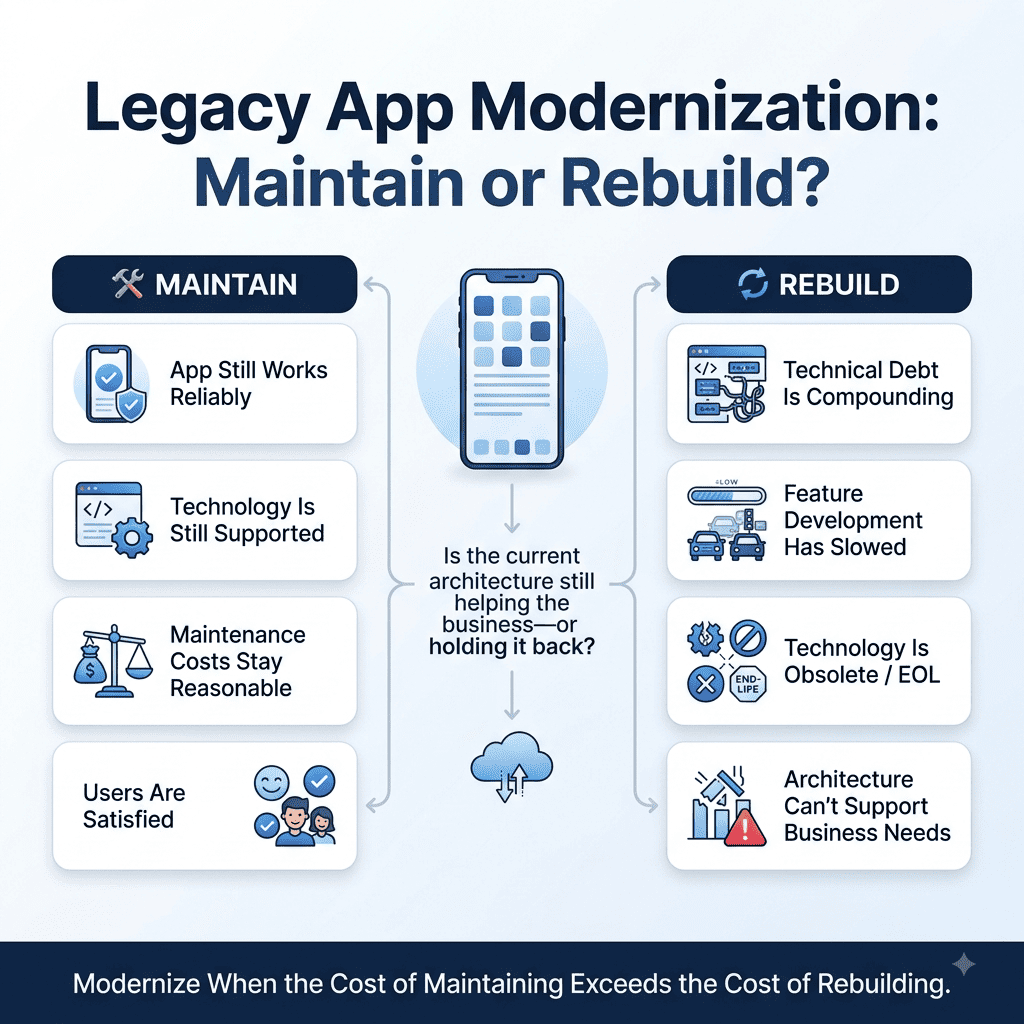
Rebuild vs. Maintain: A Decision Framework
Factor | Favors Maintaining | Favors Rebuilding |
App reliability | Stable, low crash/error rates | Frequent, worsening instability |
Technology support status | Actively supported, patched | End-of-life, unsupported |
Feature delivery speed | Reasonable, matches team capacity | Severely degraded, simple work takes too long |
Maintenance cost trend | Flat or slowly rising | Rising sharply year over year |
Business capability gap | Current architecture meets real needs | Architecture blocks needed capability |
Most real situations don’t land cleanly on one side of this table, which is exactly why a genuine technical audit, not a gut feeling in either direction, is worth doing before committing to either path.
Modernization Approaches Short of a Full Rebuild
The Strangler Fig Pattern
For businesses leaning toward modernization but wary of a full, disruptive rebuild, the strangler fig pattern, gradually extracting and replacing individual pieces of a legacy system while the rest continues running, offers a middle path. It lets a team modernize incrementally, validating each replaced piece in production before committing further, rather than betting the entire business on a single, high-risk, big-bang rewrite.
Targeted Refactoring of High-Debt Areas
Rather than rebuilding an entire app, identifying and refactoring the specific modules carrying the most technical debt, usually the ones causing the most bugs or slowing feature delivery the most, can capture much of a rebuild’s benefit at a fraction of the cost and risk.
The Real Cost of Delaying a Needed Modernization
Deferring a genuinely overdue modernization doesn’t freeze the problem in place, it compounds it. Technical debt accumulates interest the longer it goes unaddressed, meaning the eventual modernization, whenever it finally happens, costs more than it would have cost earlier. Security risk compounds too, an unsupported technology stack accumulates unpatched vulnerabilities the longer it stays in production. And the business opportunity cost, features that can’t ship, integrations that can’t be built, competitors moving faster on a modern stack, tends to be the least visible cost on a spreadsheet but often the most expensive one in practice, since it shows up as lost revenue rather than a clear, itemized budget line.
Common Mistakes in Legacy App Modernization Decisions
Businesses frequently default to “rebuild everything” because a full rewrite feels more decisive and satisfying than the harder work of honestly assessing which specific parts of an app actually need it, resulting in a far more expensive, riskier project than the situation warranted. The opposite mistake, indefinitely deferring any modernization because the current app “still works,” ignores the compounding cost covered above, and the business often only recognizes the real cost once a competitor moving faster on modern infrastructure has already captured the market opportunity.
Rebuilds also frequently get scoped as a single, all-at-once cutover rather than an incremental strangler fig approach, dramatically raising the risk of the project without a corresponding benefit. Our signs your app needs a maintenance overhaul guide covers the earlier-stage diagnostic signals worth watching before a maintenance problem becomes a full modernization decision, catching the pattern while a smaller intervention is still viable.
How The Apps Developers Approaches Legacy App Modernization
We start every modernization conversation with a genuine technical audit, not a predetermined recommendation toward either rebuilding or patching, as part of the same Mobile App Development process we bring to any project, new or decades old.
For businesses choosing an incremental approach, the infrastructure work behind a strangler fig migration, running legacy and modernized components side by side safely, runs through the same DevOps and cloud solutions practice that supports any complex deployment strategy.
If you’re not sure whether your app needs a full rebuild, a targeted refactor, or just better ongoing maintenance, that’s exactly the kind of decision worth an honest, evidence-based conversation before committing a budget either way. You’re welcome to talk to our team about what an honest assessment of your specific app would actually reveal.