
To hire a Flutter developer, evaluate real production experience with Dart, Flutter architecture, state management, APIs, testing, performance, native integrations, and App Store and Google Play deployment rather than relying on years of experience alone. In 2026, freelance Flutter talent commonly starts around $18 to $39 per hour on broad marketplaces, while experienced vetted developers and full time hires can cost considerably more depending on seniority, location, and project complexity.
If your real goal is to add experienced Flutter talent without building a recruiting pipeline from scratch, The Apps Developers provides Hire Certified Software Developers who can join an existing development team and work within its product, sprint, repository, and communication processes.
Knowing how to hire a Flutter developer matters because Flutter experience is surprisingly easy to exaggerate on a resume.
A developer can complete a few tutorials, assemble screens from packages, connect Firebase, and reasonably say they have worked with Flutter.
That does not mean they can architect a product that will still be maintainable after three years, diagnose a performance issue that appears only on lower end Android devices, integrate a native iOS SDK, design an offline synchronization strategy, or safely release an update to thousands of users.
Those are different levels of engineering maturity.
For a small prototype, that distinction may not matter much.
For a funded startup, ecommerce platform, fintech product, healthcare application, SaaS companion app, marketplace, or enterprise Mobile App Development project, it matters enormously.
The wrong Flutter hire rarely fails because they cannot make a button work.
They fail when the product becomes more complex than the tutorial patterns they know.
This guide explains what to look for, what flutter developers cost in 2026, which interview questions reveal genuine engineering depth, what practical test to assign, and how to choose between freelancers, in-house developers, dedicated developers, and an experienced development company.
What Is a Flutter Developer?
A Flutter developer is a software engineer who uses Google’s Flutter framework and the Dart programming language to build applications that can run across platforms such as iOS, Android, web, and desktop from a largely shared codebase.
Flutter’s architecture is designed around code reuse while still allowing developers to interact with underlying platform services when required. Google’s Flutter documentation describes the framework as a cross platform UI toolkit designed to deliver high performance experiences while sharing as much code as practical across platforms.
That last part is important when hiring.
A good Flutter developer is not simply someone who knows Flutter widgets.
They understand where shared Flutter code is the right solution and where native platform knowledge is required.
A production application may still need Swift, Objective C, Kotlin, Java, native SDK integrations, platform channels, Apple and Google configuration, background services, permissions, deep links, push notifications, device hardware, or platform specific debugging.
That is why the best Flutter developers usually understand Mobile App Development beyond the Flutter framework itself.
Why Businesses Hire Flutter Developers
Flutter is attractive because one development team can support multiple platforms without maintaining completely separate iOS and Android codebases for every product feature.
That can reduce duplicate development work, simplify feature parity, and make Mobile App Development easier to coordinate.
It does not automatically make every project cheaper or easier.
The framework fits particularly well when:
- You need iOS and Android applications with similar functionality.
- Your product uses a substantial amount of custom interface design.
- You want one core mobile engineering team.
- Rapid iteration matters.
- Most product logic can be shared across platforms.
- You expect frequent feature releases on both operating systems.
- Your application does not depend overwhelmingly on platform exclusive functionality.
If you are still deciding whether cross platform development itself makes sense, read our Native vs Cross Platform Development comparison before hiring around a framework decision that has not actually been made.
And if the choice has narrowed specifically to Flutter and React Native, our Flutter vs React Native guide compares the two from the perspective of cost, performance, hiring, maintainability, and long term product fit.
How to Hire a Flutter Developer Based on the Work You Actually Need
The first step is not writing a job description.
It is defining what the developer needs to own.
A Flutter developer hired to implement finished Figma screens needs a different skill profile from someone responsible for rebuilding the architecture of a three year old application.
Start by placing your requirement into one of these categories.
| Requirement | Typical Developer Level |
| Convert designs into simple Flutter screens | Junior |
| Add features to an established Flutter codebase | Junior to mid level |
| Build an MVP with APIs and Firebase | Mid level |
| Own a production Flutter application | Mid to senior |
| Design application architecture | Senior |
| Solve complex performance problems | Senior |
| Integrate custom native SDKs | Senior |
| Lead a Flutter engineering team | Senior or lead |
| Modernize a poorly structured legacy app | Senior |
| Own mobile CI/CD and store releases | Mid to senior |
Hiring somebody more senior than necessary increases cost.
Hiring somebody too junior creates a much more expensive problem.
The right target is the lowest level of seniority that can safely own the problem you need solved.
Flutter Developer Skills to Look for in 2026
1. Strong Dart Programming Skills
Dart is the programming language used by Flutter.
A serious Flutter developer should understand more than Dart syntax.
Look for practical knowledge of:
- Object oriented programming
- Null safety
- Futures
- Streams
- Async and await
- Error handling
- Generics
- Collections
- Extensions
- Mixins
- Isolates where appropriate
- Immutability
- Dependency management
- Code organization
A candidate who understands Flutter visually but struggles with asynchronous Dart code will eventually struggle with real APIs, local databases, background operations, and complex application state.
Ask candidates to explain how they have used Futures and Streams in an actual application.
Real examples reveal more than definitions.
2. Flutter Widget and UI Knowledge
Flutter developers need a strong understanding of the framework’s widget model.
They should comfortably explain when and why they use StatelessWidget, StatefulWidget, inherited state, composition, reusable widgets, keys, layouts, themes, navigation, responsive design, and platform specific UI behavior.
Do not stop at asking whether they know these terms.
Ask them to open one of their applications and explain how they structured a complex screen.
A strong developer should be able to explain why the code was organized that way.
That ability to explain tradeoffs is one of the most useful hiring signals you can get.
3. Flutter App Architecture
Good Flutter App Architecture Becomes More Important as the Product Grows
Flutter app architecture is the way application responsibilities, UI, state, business logic, data access, and external services are separated and organized.
Google’s current Flutter architecture guidance emphasizes maintainability, resilience, scalability, separation of concerns, testability, repositories, services, and clearly structured application layers.
This is a major dividing line between someone who can build screens and someone who can own a product.
Ask candidates how they would organize:
- Authentication
- API communication
- Local storage
- Business logic
- Application state
- Error handling
- Navigation
- Analytics
- Feature modules
- Environment configuration
A weak candidate will often name an architecture without explaining it.
A stronger candidate will discuss why the architecture fits the size of your team and application.
That distinction matters.
There is no prize for using the most complicated architecture.
Good architecture makes the product easier to change.
4. Flutter State Management
A Strong Developer Can Explain Why They Chose a State Management Approach
State management questions frequently become pointless framework debates.
- Provider.
- Riverpod.
- BLoC.
- Cubit.
- GetX.
The name matters less than the reasoning.
A senior candidate should be able to explain how state moves through the application, how dependencies are handled, how UI components react to changes, how logic stays testable, and why one approach fits the team’s needs.
Ask:
“Which state management approach did you use in your last production application, and what problem did it solve?”
Then follow with:
“What did you dislike about that approach?”
That second question is particularly useful.
Developers with real production experience usually know the weaknesses of tools they like.
5. Backend and API Integration Skills
Most Flutter applications depend heavily on backend systems.
A developer should understand REST APIs, JSON serialization, authentication tokens, pagination, caching, error states, retries, timeouts, file uploads, web sockets where needed, and secure communication.
For products with substantial server side requirements, pairing Flutter talent with experienced API and Backend Development is important because an excellent mobile client cannot compensate for an unreliable backend.
Ask a candidate what their application does when an API:
- Returns an error
- Times out
- Returns partial data
- Sends an expired authentication response
- Becomes temporarily unavailable
- Returns unexpected data
Experienced developers think about these cases before users discover them.
6. Native iOS and Android Knowledge
A Flutter developer does not need to be an expert native engineer for every project.
They should understand where Flutter ends and native platforms begin.
That includes working knowledge of:
- Platform channels
- Native permissions
- App lifecycle differences
- Push notifications
- Deep links
- Background execution
- Apple signing and provisioning
- Android build configuration
- App Store deployment
- Google Play deployment
- Native SDK integration
If your application uses Bluetooth, NFC, camera processing, payments, maps, health data, biometrics, background location, or specialized hardware, native knowledge becomes significantly more important.
7. Firebase Experience
Firebase appears frequently in Flutter projects because it can provide authentication, databases, analytics, crash reporting, notifications, remote configuration, and other application services.
But “Firebase experience” should not be reduced to adding a package.
Ask what the developer has actually implemented.
Someone who has used Firebase Authentication once is different from someone who has designed security rules, push notification flows, Crashlytics monitoring, analytics events, offline behavior, and scalable data structures.
Flutter Testing Skills
A Production Flutter Developer Should Understand More Than Manual Testing
Flutter officially supports unit tests, widget tests, and integration tests. Google’s Flutter documentation recommends many unit and widget tests alongside enough integration tests to cover important user flows.
When learning how to hire a Flutter developer, ask candidates what they test and what they deliberately do not test.
That is more useful than asking whether they “write tests.”
A capable developer should understand:
- Unit testing
- Widget testing
- Integration testing
- Mocking or fakes
- Regression testing
- API failure testing
- Device testing
- CI testing
Testing Judgment Matters More Than a Coverage Percentage
An impressive coverage number can still hide poor tests.
Ask the candidate to describe a bug that automated testing prevented from reaching production.
Real production developers tend to remember those stories.
Flutter Performance Optimization Skills
Flutter performance problems often appear only once an application reaches real devices, large datasets, complex animations, image heavy screens, or long running sessions.
A senior Flutter developer should know how to diagnose rather than guess.
Look for experience with Flutter DevTools, profiling, unnecessary widget rebuilds, memory issues, large lists, image handling, asynchronous work, rendering performance, and application startup.
Ask:
“A screen scrolls smoothly on a flagship phone but drops frames on a lower end Android device. How would you investigate?”
The answer should involve measurement.
Be cautious if the candidate immediately proposes rewriting code without first profiling the problem.
UI/UX Implementation Skills
Flutter gives developers substantial control over interface rendering, but technical accuracy does not automatically create a good user experience.
A developer should be able to translate design systems into reusable components, support different screen sizes, handle text scaling, respect accessibility considerations, implement loading and error states, and maintain visual consistency.
For products where interface quality is a competitive differentiator, combining engineering with dedicated UI/UX Design services reduces the risk of making developers invent product decisions while they code.
A useful interview test is to show the candidate a Figma screen and ask them what information is missing before development begins.
Strong developers often notice states designers have not shown.
- What happens when the list is empty?
- What happens while data is loading?
- What happens when an image fails?
- What happens when the user’s text is unusually long?
That thinking is valuable.
How Much Does It Cost to Hire a Flutter Developer in 2026?
The cost to hire a Flutter developer can range from under $20 per hour on broad freelance marketplaces to $100 per hour or more for vetted senior specialists, while a full time US Flutter developer can approach or exceed six figures annually.
There is no universal Flutter developer hourly rate.
Current Upwork marketplace data lists typical Flutter developer rates around $18 to $39 per hour, although individual rates vary with skill, geography, scope, and experience.
At the higher end of the contract market, Arc reports that Flutter developers in its vetted network typically charge around $60 to $100+ per hour.
For US employment, ZipRecruiter’s September 2026 data reports an average Flutter developer salary of approximately $98,514 per year, with substantial variation across experience levels and locations.
These numbers are useful as market reference points, not fixed prices.
Flutter Developer Cost by Experience
| Developer Level | Typical Work | Cost Position |
| Junior Flutter developer | UI implementation, straightforward APIs, bug fixes | Lowest |
| Mid level Flutter developer | Feature ownership, state management, APIs, releases | Medium |
| Senior Flutter developer | Architecture, performance, native integrations, technical ownership | High |
| Flutter tech lead | Architecture, mentoring, delivery oversight, team decisions | Highest |
Rate alone tells you very little.
A developer costing $25 per hour who needs 500 hours to solve a problem is not cheaper than one costing $60 per hour who solves it correctly in 150.
Evaluate total delivery economics.
If you need a broader project budget rather than an individual developer rate, our Mobile App Development Cost guide covers the cost drivers beyond developer salaries, including design, backend development, testing, infrastructure, and ongoing support.
What Affects Flutter Developer Cost?
Several variables influence what you will pay.
Seniority
Senior developers cost more because you are buying judgment as much as coding output.
They should require less direction, make stronger architecture decisions, identify risk earlier, and solve less familiar problems independently.
Location
Hiring markets differ substantially across North America, Western Europe, Eastern Europe, Latin America, South Asia, Southeast Asia, and other regions.
Remote hiring gives businesses access to much wider rate ranges.
Do not judge geography purely through hourly cost.
English communication, timezone overlap, employment structure, contract protection, retention, and engineering quality all affect the real value of the hire.
Project Complexity
A developer maintaining a simple content application requires a different skill set from someone building real time video, fintech transactions, Bluetooth integrations, offline synchronization, or advanced animations.
Specialization increases rates.
Engagement Length
A developer may price a short consulting engagement differently from a six month full time contract.
Longer engagements can give both sides greater predictability.
Hiring Channel
Freelance marketplaces, recruitment firms, direct employment, staffing companies, and software development agencies all have different cost structures.
You are paying for different levels of sourcing, screening, replacement support, management, and delivery responsibility.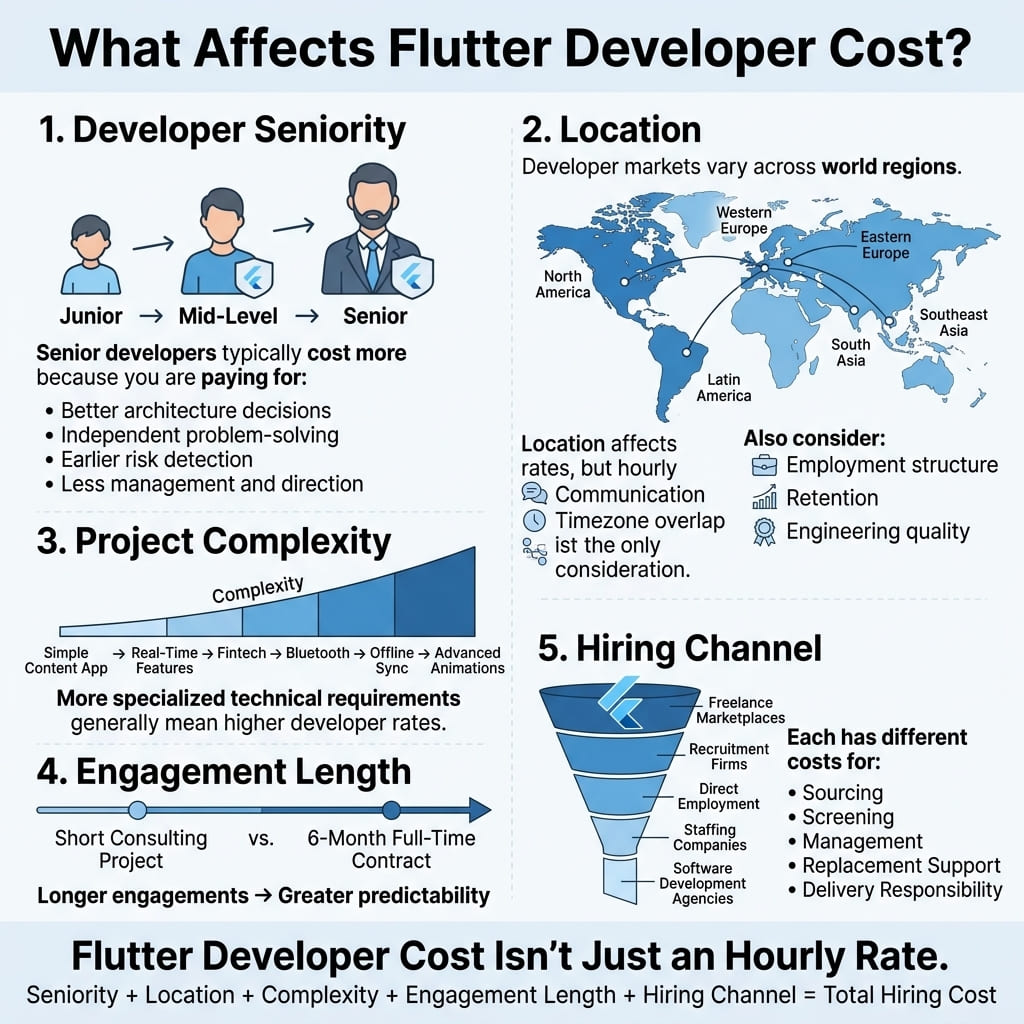
Freelance vs In House vs Dedicated Flutter Developer vs Development Company
Choosing how to hire a Flutter developer also means choosing the right engagement model.
Hiring Model | Best For | Main Advantage | Main Risk |
Freelancer | Small tasks and flexible projects | Low commitment | Availability and continuity |
In house developer | Long term core product team | Deep internal ownership | Slow hiring and employment overhead |
Dedicated Flutter developer | Ongoing development without direct recruiting | Flexible team extension | Requires internal product management |
Development company | Complete project delivery | Wider skills and delivery ownership | Higher overall engagement cost |
Freelance Flutter Developer
A freelancer can be a strong choice when you have a clearly defined task and somebody technical on your side can review the work.
Examples include:
- Fixing bugs
- Building a specific feature
- Updating dependencies
- Improving an existing screen
- Supporting an established team
The risk grows when one freelancer becomes responsible for architecture, product discovery, UI/UX, backend development, testing, deployment, and project management simultaneously.
One person may be capable of several of those things.
Expecting excellence in all of them is another matter.
In House Flutter Developer
An in house hire makes sense when Mobile App Development is a permanent core competency of your business.
You gain direct management, stronger institutional knowledge, and long term product ownership.
The tradeoff is hiring time and fixed overhead.
Salary is only part of the cost.
Recruiting, benefits, equipment, payroll, management, retention, paid leave, and replacement costs matter too.
Remote Dedicated Flutter Developer
A dedicated Flutter developer works particularly well when you already have a product manager, engineering lead, or development team and need more execution capacity.
You get an engineer committed to the ongoing roadmap without necessarily creating a permanent employee relationship.
This model works best when requirements change frequently and there is enough work to justify ongoing capacity.
Flutter Development Company
A development company makes more sense when you do not simply need a coder.
You need delivery.
That can include product planning, Mobile App Development, UI/UX, backend architecture, QA, deployment, DevOps, and project management.
If you are deciding between individual talent and an agency engagement, our guide on how to choose a Mobile App Development company explains how to evaluate technical depth, ownership, communication, security, portfolio quality, and post launch support.
Flutter Developer Hiring Process: A Practical 7 Step Framework
Step 1: Define What the Developer Will Own
Write outcomes, not buzzwords.
Poor requirement:
“Need Flutter expert with Dart and Firebase.”
Better requirement:
“Own development of our Flutter customer application for iOS and Android, including API integration, Riverpod based state management, automated tests, App Store releases, and ongoing feature development.”
Specific ownership attracts more relevant candidates.
Step 2: Set the Required Seniority
Do not default to senior.
Ask whether the person will:
- Receive detailed technical direction
- Make architecture decisions
- Review other developers
- Own production releases
- Work with native code
- Design API contracts
- Solve performance problems independently
The more “yes” answers you have, the more senior your hire probably needs to be.
Step 3: Review Real Applications
Ask for App Store and Google Play links.
Then ask what the candidate personally built.
Do not assume that being on a team means they owned everything in the portfolio.
Ask them to open one project and explain:
- The architecture
- Their responsibilities
- Hardest technical problem
- State management approach
- Testing strategy
- Backend integration
- What they would change today
The final question is powerful.
Good engineers see weaknesses in their old work because their judgment has evolved.
Step 4: Review Code
GitHub can help, but candidates working on commercial software may not have public repositories.
That is normal.
If code cannot be shared, use a live technical discussion or controlled practical task.
Focus on clarity, maintainability, naming, separation of responsibilities, error handling, testing, and decision making.
Do not obsess over formatting preferences.
Step 5: Conduct a Technical Interview
Technical interviews should explore reasoning, not memorization.
A candidate can search the definition of StatefulWidget in seconds.
What you actually need to know is whether they can use Flutter to solve your product problems.
Flutter Developer Interview Questions That Reveal Real Skill
Question 1: Tell me about the most difficult Flutter application you have shipped.
What to listen for: Specific technical problems, constraints, decisions, results, and personal ownership.
Weak candidates describe the application’s features.
Strong candidates describe the engineering decisions behind those features.
Question 2: How would you structure a Flutter application expected to grow for three years?
What to listen for: Separation of concerns, architecture based on project size, state management, data layers, repositories, testing, feature boundaries, and maintainability.
Be cautious of candidates who insist one architecture is correct for every product.
Question 3: How do you choose a Flutter state management solution?
What to listen for: Reasoning around complexity, team familiarity, testability, maintainability, dependency handling, and product requirements.
A tool name is not an answer.
Question 4: What happens when a network request fails halfway through an important workflow?
What to listen for: Error states, retries where safe, idempotency awareness, user feedback, logging, caching, data consistency, and recovery behavior.
This reveals whether the candidate thinks beyond the happy path.
Question 5: How do you investigate Flutter performance problems?
What to listen for: Profiling, Flutter DevTools, rebuild analysis, frame performance, memory, image handling, device comparison, and measurement before optimization.
Question 6: When would Flutter require native iOS or Android code?
What to listen for: Platform channels, unsupported SDKs, specialized hardware, background services, platform APIs, native configuration, and limitations of available plugins.
Question 7: How do you test Flutter applications?
What to listen for: Unit, widget, and integration tests combined according to risk.
Google’s current Flutter testing guidance separates these test levels and recommends combining them rather than depending exclusively on manual testing.
Question 8: Tell me about a production bug you caused.
This is one of the best seniority questions.
What to listen for: Ownership.
Strong engineers usually explain what happened, how they found it, how they fixed it, and what process or test they added afterward.
Be cautious when candidates claim they have never caused a meaningful bug.
Question 9: How would you build an offline first Flutter feature?
What to listen for: Local storage, synchronization, conflict handling, data freshness, connection state, retries, and user experience.
Question 10: How do you evaluate a Flutter package before adding it?
What to listen for: Maintenance activity, documentation, compatibility, platform support, open issues, security implications, package quality, licensing, and whether the dependency is genuinely necessary.
Question 11: Tell me about an App Store or Google Play release problem you solved.
What to listen for: Real deployment experience.
A developer who has owned production releases should be able to discuss signing, build configuration, store requirements, testing, rejected builds, versioning, or platform differences.
Question 12: What part of Flutter would you not use Flutter for?
This reveals engineering maturity quickly.
A strong Flutter developer should not believe Flutter is automatically the best answer to every software problem.
Step 6: Give the Candidate a Practical Flutter Test
Do not assign a three day unpaid project.
A focused exercise of roughly one to three hours can reveal plenty when designed correctly.
For example:
Build a small Flutter application that retrieves products from a mock API, displays loading and error states, supports a details screen, stores favorites locally, and includes tests for one meaningful piece of logic.
Then ask the candidate to explain their decisions.
Score the work across:
Area | Weight |
Code organization | 20% |
Flutter fundamentals | 15% |
State management | 15% |
Error handling | 10% |
Testing | 15% |
UI quality | 10% |
Maintainability | 10% |
Explanation and communication | 5% |
The discussion after the test is often more valuable than the code.
Ask what they would improve with another day.
Step 7: Evaluate Communication Before Making the Hire
Mobile development is collaborative work.
Flutter developers work with designers, backend developers, QA engineers, product managers, stakeholders, and sometimes customers.
Look for someone who can:
- Explain technical tradeoffs clearly
- Raise blockers early
- Ask good questions
- Estimate without pretending certainty
- Receive code review feedback
- Challenge unclear requirements respectfully
- Document important decisions
- Communicate when something will not work as planned
A technically strong developer who disappears whenever a problem occurs can become a serious delivery risk.
Flutter Developer Red Flags
Knowing how to hire a Flutter developer also means knowing when not to hire one.
Watch for these signals.
They Cannot Explain Their Own Portfolio
If a candidate says “we built” repeatedly, ask what they personally implemented.
They Choose Libraries Without Tradeoffs
Experienced developers rarely believe one package is perfect for every project.
They Have Never Released an Application
This is not automatically disqualifying for junior developers.
It is concerning for somebody applying as a senior Flutter developer.
They Ignore Testing
“QA tests it” is not a sufficient answer from a senior engineer.
Developers need responsibility for code quality too.
They Cannot Discuss Native Platforms
A senior Flutter developer should understand that real world cross platform development eventually touches iOS and Android specifics.
They Overpromise Timelines
Good engineers understand uncertainty.
Someone promising a complex production app in two weeks before examining requirements is selling confidence, not providing an estimate.
They Never Ask About the Product
Strong developers want context.
They ask who uses the application, why the feature matters, what systems exist already, and which constraints matter most.
Should You Hire One Flutter Developer or a Full Team?
One Flutter developer can be enough when your company already provides design, backend development, QA, product management, and technical leadership.
A complete application often requires more.
A typical Mobile App Development team may include:
- Product manager
- UI/UX designer
- Flutter developer
- Backend developer
- QA engineer
- DevOps engineer
- Technical lead
Not every project needs seven separate people full time.
The point is that those responsibilities still exist.
If one Flutter developer is being asked to perform all of them, make that decision knowingly.
The broader Mobile App Development process can help you identify which disciplines your project will need before you start recruiting.
How to Hire a Flutter Developer Without Overpaying
Do not optimize for the cheapest hourly rate.
Optimize for the cost of getting a maintainable product into production.
You can control hiring cost by:
- Defining responsibilities before sourcing candidates
- Hiring the right seniority instead of automatically hiring senior
- Preparing designs and requirements before expensive engineering begins
- Separating backend responsibilities from Flutter work when necessary
- Using a focused technical assessment
- Reviewing production experience before interviews
- Choosing the right engagement model
- Starting with a short paid trial where practical
- Measuring delivery quality, not hours alone
- Avoiding developers who need to learn critical technologies during the project
A $20 hourly rate is expensive when every feature needs to be rebuilt.
A higher rate can be inexpensive when the developer prevents architectural problems before they happen.
When a Dedicated Flutter Developer Makes More Sense Than Direct Hiring
Direct hiring works well when you want to build permanent internal engineering capability and are comfortable owning recruitment, HR, retention, technical screening, and replacement.
A dedicated developer model becomes attractive when you need development capacity sooner or want the flexibility to scale the team according to the roadmap.
For example, a startup might need two Flutter developers for the six months leading to launch, one developer during steady state development, then additional engineering capacity for a major new feature.
Permanent hiring is not always flexible enough for that pattern.
The key is making sure “dedicated” genuinely means the developer is allocated to your project and participates in your normal workflow.
Ask vendors directly:
- Is this developer assigned full time?
- Who manages the developer daily?
- Can we communicate with them directly?
- Who owns the source code?
- What happens if the developer leaves?
- How is knowledge transferred?
- Can we scale the team up or down?
- Are replacement terms documented?
These questions expose the difference between true staff augmentation and a vendor simply reselling developer hours.
How The Apps Developers Approaches Flutter Hiring
Finding a developer is not difficult.
Finding somebody who can safely own part of your product is.
The Apps Developers focuses on giving businesses access to developers who can operate inside real delivery environments rather than simply forwarding resumes.
That means evaluating technical competence alongside the practical skills needed to contribute to production software: code quality, architecture awareness, communication, API integration, testing, version control, debugging, product understanding, and collaboration.
For businesses that need more than an individual developer, our Mobile App Development services can support the complete product lifecycle, including strategy, design, engineering, backend integration, testing, release, and ongoing development.
The right engagement ultimately depends on what you already have.
If you have a strong engineering organization and simply need capacity, hire the developer.
If you need somebody to own the entire delivery process, hire the team.
Confusing those two needs is where many software hiring problems begin.
Conclusion
Learning how to hire a Flutter developer is less about memorizing a checklist of technologies and more about matching engineering ability to product responsibility.
For straightforward interface work, a competent junior developer may be exactly what you need.
For a growing production application, look for someone who understands Dart, architecture, state management, APIs, testing, debugging, performance, native platforms, and production releases.
For a product whose architecture, security, scalability, or delivery timeline carries significant business risk, seniority becomes much more important.
The most useful question during the entire hiring process is not:
“How many years of Flutter experience do you have?”
Ask:
“What can this developer safely own without somebody more senior having to fix it later?”
That question changes how you read portfolios, how you structure interviews, how you evaluate test tasks, and how you compare hourly rates.
It also makes Flutter developer cost easier to understand.
You are not buying hours.
You are buying the ability to move a real product forward without quietly creating tomorrow’s technical problems.
If your team already has product and technical leadership, a dedicated Flutter developer may provide exactly the capacity you need.
If you need discovery, UI/UX, Mobile App Development, backend development, QA, release management, and ongoing support as one coordinated effort, a full product team is usually the safer choice.
Either way, hire around the responsibility the product actually requires.
That is how you choose a Flutter developer who can do more than write code.
It is how you choose one who can help you ship.